IMPACT
Results & Outcomes
15+
Platform enhancements shipped
3
Architectural layers coordinated
↓
PR review cognitive switching
↑
Leadership decision confidence
USER FEEDBACK
"For the first time, I can see exactly where engineering effort is going and whether it's working."
"The PR review flow finally feels like it was designed for how we actually work."
Copyright @ 2025 Yash Gupta
All Rights Reserved
Made with Love ❤️ | Coffee ☕️ | Music 🎧
CONTEXT & BACKGROUND
INDUSTRY
Enterprise SaaS / Engineering Intelligence
WHY THIS MATTERS
Cubyts is an enterprise SaaS platform used to improve engineering quality, visibility, and governance. As adoption grew, feature velocity increased but structural clarity did not scale with it. The product wasn't broken. It was becoming heavy. Reporting was dense but not decisive. PR workflows were functional but fragmented. Governance systems were powerful but cognitively expensive. The risk wasn't usability the risk was long-term scalability.
GAPS IN EXISTING SOLUTIONS
Reporting surfaces exposed data without enabling decisions
PR review workflows caused context loss and screen-switching fatigue
Governance configuration was powerful but created cognitive overload
No structural cohesion across 15+ feature enhancements
PROBLEM STATEMENT
"Cubyts had depth. It lacked structural cohesion."
01
Leadership needed decision-ready engineering visibility not metric overload
02
Developers needed frictionless PR workflows not navigation fatigue
03
Admins needed flexible governance systems without risking configuration chaos
ROLE & SCOPE
OWNERSHIP
Platform-wide transformation, 15+ enhancements across reporting, governance systems, PR workflows, integrations, and modernization architecture
COLLABORATION
Worked with engineering leads, product managers, QA, and enterprise stakeholders across multiple squads
CONSTRAINTS
Enterprise-grade complexity design decisions had cascading effects across modules
Existing user workflows could not be disrupted changes had to be backward-compatible
High cognitive load interfaces required reduction without sacrificing depth
RESEARCH
Raw & Honest Discovery
PARTICIPANTS
Enterprise engineering teams across multiple organizations
METHODS
Stakeholders interview
Heuristic evaluation
Workflow audits
Cognitive walkthrough
Analytics review
WHAT USERS SAID
"I have all the data I need, but I still can't tell if we're on track."
- Engineering Lead
"Every PR review requires me to switch between five different screens."
- Senior Developer
"The governance config is powerful, but I'm always afraid I'll break something."
- Platform Admin
01
Data richness without signal hierarchy created decision paralysis
PATTERNS DISCOVERED
02
Workflow fragmentation was the primary source of developer friction
03
Configuration power without structural guardrails created admin anxiety
KEY INSIGHTS
What the research revealed
01
INSIGHT
Data without hierarchy is noise
WHY
Leaders had access to all metrics but couldn't identify what required action
DESIGN IMPLICATION
Restructure reporting into a signal hierarchy surface what needs attention first
02
INSIGHT
Context loss is the invisible tax on developer productivity
WHY
PR reviewers spent more time re-establishing context than actually reviewing
DESIGN IMPLICATION
Persistent, inline contextual panels eliminate the need for screen-switching
03
INSIGHT
Configuration power needs structural guardrails
WHY
Admins avoided using powerful features out of fear of creating inconsistencies
DESIGN IMPLICATION
Wizard-based flows and explicit dependency visibility reduce configuration anxiety
PRODUCT DIRECTION
Guiding principles
Signal over data
Surfaces what requires action, not just what exists
Context persistence
Relevant information stays visible throughout workflows
Controlled complexity
Enterprise depth without cognitive chaos
PRIORITIES
Engineering Intelligence
Workflow & Governance Optimization
Platform Modernization & Scalability
TRADE-OFFS
Chose coordinated system evolution over isolated redesigns, ensuring every enhancement mapped to one of three architectural layers for structural cohesion.
Signal over data
Surfaces what requires action, not just what exists
Context persistence
Relevant information stays visible throughout workflows
Controlled complexity
Enterprise depth without cognitive chaos
PRIORITIES
Engineering Intelligence
Workflow & Governance Optimization
Platform Modernization & Scalability
INTERACTION DESIGN
Dynamic Feature Showcase
KEY SCREENS
Design solutions
MICRO-INTERACTIONS & EDGE CASES
The details that matter
EMPTY STATES
Contextual guidance at every empty state, directing users to the right configuration action rather than leaving blank interfaces
ERROR-HANDLING
Explicit validation states with clear critical action signaling, especially for destructive migration operations
SMART NUDGES
Progressive disclosure patterns surface complexity only when needed, reducing cognitive load on first encounter
REFLECTION
Looking back
Cubyts evolved from a feature-expanding SaaS tool into a structured engineering intelligence platform with a design system capable of scaling further without losing coherence.
I'd love to walk you through the design system in detail during our conversation.
IMPACT
Results & Outcomes
15+
Platform enhancements shipped
3
Architectural layers coordinated
↓
PR review cognitive switching
↑
Leadership decision confidence
USER FEEDBACK
"For the first time, I can see exactly where engineering effort is going and whether it's working."
"The PR review flow finally feels like it was designed for how we actually work."
Cubyts
Re-Architecting an Engineering Intelligence Platform at Scale
R O L E
Product Designer
T I M E L I N E
3 Months
T O O L S
Figma, FigJam, GenAi, Notion, Jira
CONTEXT & BACKGROUND
INDUSTRY
Enterprise SaaS / Engineering Intelligence
WHY THIS MATTERS
Cubyts is an enterprise SaaS platform used to improve engineering quality, visibility, and governance. As adoption grew, feature velocity increased but structural clarity did not scale with it. The product wasn't broken. It was becoming heavy. Reporting was dense but not decisive. PR workflows were functional but fragmented. Governance systems were powerful but cognitively expensive. The risk wasn't usability the risk was long-term scalability.
GAPS IN EXISTING SOLUTIONS
Reporting surfaces exposed data without enabling decisions
PR review workflows caused context loss and screen-switching fatigue
Governance configuration was powerful but created cognitive overload
No structural cohesion across 15+ feature enhancements
PROBLEM STATEMENT
"Cubyts had depth. It lacked structural cohesion."
01
Leadership needed decision-ready engineering visibility not metric overload
02
Developers needed frictionless PR workflows not navigation fatigue
03
Admins needed flexible governance systems without risking configuration chaos
ROLE & SCOPE
OWNERSHIP
Platform-wide transformation, 15+ enhancements across reporting, governance systems, PR workflows, integrations, and modernization architecture
COLLABORATION
Worked with engineering leads, product managers, QA, and enterprise stakeholders across multiple squads
CONSTRAINTS
Enterprise-grade complexity design decisions had cascading effects across modules
Existing user workflows could not be disrupted changes had to be backward-compatible
High cognitive load interfaces required reduction without sacrificing depth
RESEARCH
Raw & Honest Discovery
PARTICIPANTS
Enterprise engineering teams across multiple organizations
Workflow audits
Cognitive walkthrough
WHAT USERS SAID
"I have all the data I need, but I still can't tell if we're on track."
- Engineering Lead
"Every PR review requires me to switch between five different screens."
- Senior Developer
"The governance config is powerful, but I'm always afraid I'll break something."
- Platform Admin
01
Data richness without signal hierarchy created decision paralysis
PATTERNS DISCOVERED
02
Workflow fragmentation was the primary source of developer friction
03
Configuration power without structural guardrails created admin anxiety
KEY INSIGHTS
What the research revealed
01
INSIGHT
Data without hierarchy is noise
WHY
Leaders had access to all metrics but couldn't identify what required action
DESIGN IMPLICATION
Restructure reporting into a signal hierarchy surface what needs attention first
02
INSIGHT
Context loss is the invisible tax on developer productivity
WHY
PR reviewers spent more time re-establishing context than actually reviewing
DESIGN IMPLICATION
Persistent, inline contextual panels eliminate the need for screen-switching
03
INSIGHT
Configuration power needs structural guardrails
WHY
Admins avoided using powerful features out of fear of creating inconsistencies
DESIGN IMPLICATION
Wizard-based flows and explicit dependency visibility reduce configuration anxiety
PRODUCT DIRECTION
Guiding principles
INTERACTION DESIGN
Dynamic Feature Showcase
Delivery Outcome Report
Engineering activity → business intelligence. Contextual metrics, zero overload.
02
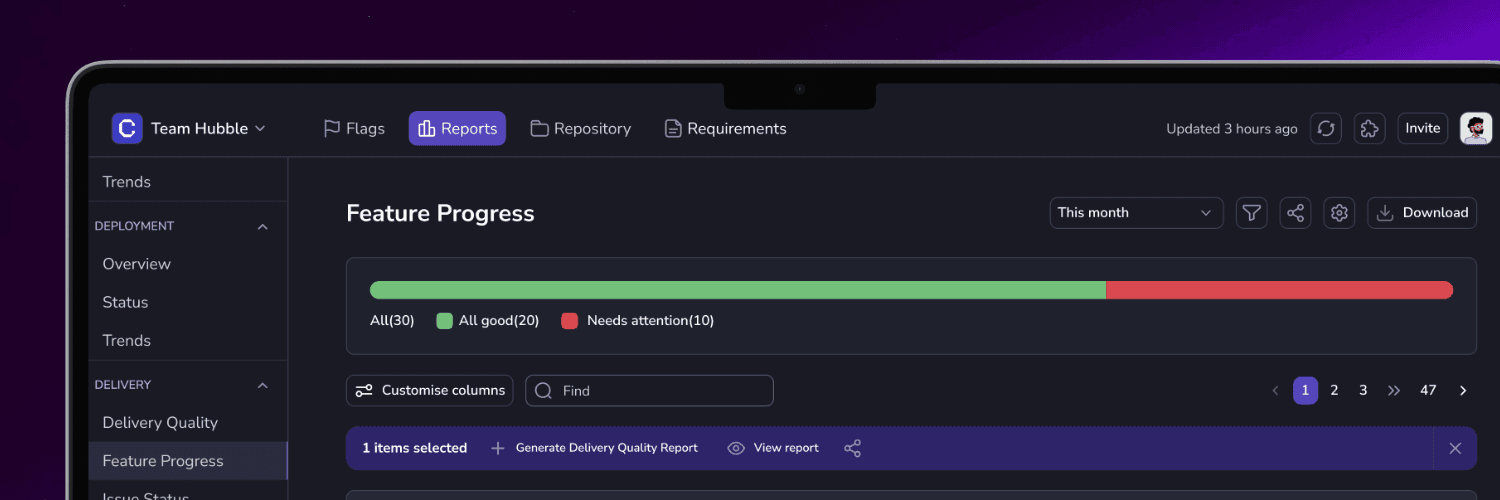
Feature Health Report
Signal hierarchy with progressive disclosure, leadership view to sprint drill-down.
01
PR Flag Configuration
Customizable flag types with inline issue configuration. Granular control, zero ambiguity.
03
KEY SCREENS
Design solutions
PR Review - Contextual RHS Panel
PROBLEM
PR reviews required screen-switching, causing constant context loss in high-volume environments
SOLUTION
Persistent inline right-hand panel surfaces specific code flaw details without leaving the review flow
PRD to Execution Workflow
PROBLEM
PRD workflows were fragmented across tools, making it hard to structure tasks, track updates, and maintain clarity leading to misalignment and missed changes.
SOLUTION
A centralized AI workspace that converts PRDs into structured tasks, with real-time updates, comparisons, and version tracking for seamless execution.
Solution PR & Audit Log
PROBLEM
Merge state progression was ambiguous and audit trails were inconsistent across review workflows
SOLUTION
Structured action history logs with standardized resolution states and audit-level transparency
Issue Deduplication Flow
PROBLEM
Duplicate issue creation when flags reappeared caused noise in the tracking system
SOLUTION
Conditional logic detects existing issues and presents a clear merge or update path instead
Bitbucket Integration
PROBLEM
Cross-platform state synchronization was unpredictable, causing merge feedback loop failures
SOLUTION
Structured credential inputs and clear state synchronization signals shifted the integration from reactive to reliable
MICRO-INTERACTIONS & EDGE CASES
The details that matter
EMPTY STATES
Contextual guidance at every empty state, directing users to the right configuration action rather than leaving blank interfaces
ERROR-HANDLING
Explicit validation states with clear critical action signaling, especially for destructive migration operations
SMART NUDGES
Progressive disclosure patterns surface complexity only when needed, reducing cognitive load on first encounter
REFLECTION
Looking back
WHAT I LEARNED
✓
Enterprise complexity demands architectural thinking, isolated redesigns create new fragmentation
✓
Signal hierarchy is a design problem, not a data problem - the same information can paralyze or empower
✓
Configuration systems need structural guardrails as much as creative freedom
WHAT I'D DO DIFFERENTLY
→
Would establish shared design principles earlier to align across squads faster
→
Could have introduced governance layer documentation to reduce stakeholder alignment overhead
→
Accessibility audit should be part of the initial design framework, not a later review
Cubyts evolved from a feature-expanding SaaS tool into a structured engineering intelligence platform with a design system capable of scaling further without losing coherence.
I'd love to walk you through the design system in detail during our conversation.
PARTICIPANTS
Enterprise engineering teams across multiple organizations
METHODS
Stakeholders interview
Heuristic evaluation
Workflow audits
Cognitive walkthrough
Analytics review
WHAT USERS SAID
"I have all the data I need, but I still can't tell if we're on track."
- Engineering Lead
"Every PR review requires me to switch between five different screens."
- Senior Developer
"The governance config is powerful, but I'm always afraid I'll break something."
- Platform Admin
01
Data richness without signal hierarchy created decision paralysis
PATTERNS DISCOVERED
02
Workflow fragmentation was the primary source of developer friction
03
Configuration power without structural guardrails created admin anxiety
PARTICIPANTS
Enterprise engineering teams across multiple organizations
WHAT USERS SAID
"I have all the data I need, but I still can't tell if we're on track."
- Engineering Lead
"Every PR review requires me to switch between five different screens."
- Senior Developer
"The governance config is powerful, but I'm always afraid I'll break something."
- Platform Admin
01
Data richness without signal hierarchy created decision paralysis
PATTERNS DISCOVERED
02
Workflow fragmentation was the primary source of developer friction
03
Configuration power without structural guardrails created admin anxiety
Signal over data
Surfaces what requires action, not just what exists
Context persistence
Relevant information stays visible throughout workflows
Controlled complexity
Enterprise depth without cognitive chaos
PRIORITIES
Engineering Intelligence
Workflow & Governance Optimization
Platform Modernization & Scalability
TRADE-OFFS
Chose coordinated system evolution over isolated redesigns, ensuring every enhancement mapped to one of three architectural layers for structural cohesion.
Signal over data
Surfaces what requires action, not just what exists
Context persistence
Relevant information stays visible throughout workflows
Controlled complexity
Enterprise depth without cognitive chaos
PRIORITIES
Engineering Intelligence
Workflow & Governance Optimization
Platform Modernization & Scalability
This Project is only available in Web